


Built By
Providers
From Practice
Post-acute medicine has its own rules, and Memry was written around them.
Built By
Providers From Practice
Post-acute medicine has its own rules, and Memry was written around them.


Our Founding Principle
The belief at the center of Memry is uncomplicated: the provider matters. That shouldn't need to be argued, but the tools providers use every day say otherwise.

The Problem
PALTC tools were built for facility administration and left unfinished, then stretched over post-acute medicine like a coat made for someone else.
Labs are in one system, PT notes in another, and discharge summaries buried 97 pages deep in a PDF. And The patient schedule is its own particular disaster. The tools technically function, and providers technically use them, but ask any provider what they think, and the answer is always the same: the tools make you feel like you don't matter.

Enter Memry
Memry was built by clinicians who ran the same workflows, hit the same walls, then built a tool actually cut to fit PALTC medicine.
It builds the daily patient list with visit cadence logic wired in. Every chart, lab, and med list lives on one screen — no second login, no endless tabs. Signed notes drop straight into the chart, so the next care team member isn't digging through emails or waiting on a phone call.
Designed Intentionally
Designed for providers, by providers.
For PALTC Medicine
01
Every minute spent looking costs the patient something.
Context shouldn't require digging, or walking through hallways to find a chart that isn't where it should be. We built Memry so the mental energy goes to the person in the room, not the search.
02
Every feature earned its place.
Memry was built by providers who hit these walls themselves and had to fix them before they could move on. Every feature traces back to someone who needed it and couldn't find it anywhere else.
03
If the care happened, the payment should follow.
Memry tracks quality metrics in real time against the provider's actual patient panel, so the credit for ACO participation shows up automatically.
04
We measure success by the hours we hand back to the provider.
No administrative work dressed up as time saved. If it doesn't give providers time back and patients better care, it's not on the roadmap.
Designed Intentionally
Designed for providers, by providers.
For PALTC Medicine
01
Every minute spent looking costs the patient something.
Context shouldn't require digging, or walking through hallways to find a chart that isn't where it should be. We built Memry so the mental energy goes to the person in the room, not the search.
02
Every feature earned its place.
Memry was built by providers who hit these walls themselves and had to fix them before they could move on. Every feature traces back to someone who needed it and couldn't find it anywhere else.
03
If the care happened, the payment should follow.
Memry tracks quality metrics in real time against the provider's actual patient panel, so the credit for ACO participation shows up automatically.
04
We measure success by the hours we hand back to the provider.
No administrative work dressed up as time saved. If it doesn't give providers time back and patients better care, it's not on the roadmap.
Our Team
Built by people who understand PALTC.


Sen Siva, MD
Managing Member
15+ years in medicine, including medical director roles at Genesis, Select Specialty, and OhioHealth Rehab. Sen leads Memry as Managing Member. Trained at St. George's and Wright State. Once played competitive tennis at Tufts.

Mike Heinze, MD
Managing Member
Mike leads Memry as Managing Member and has spent years as a healthcare innovator with a passion for designing systems of care delivery. He completed his MD and residency at Ohio State and practiced clinically for over a decade. He is a father of twins.
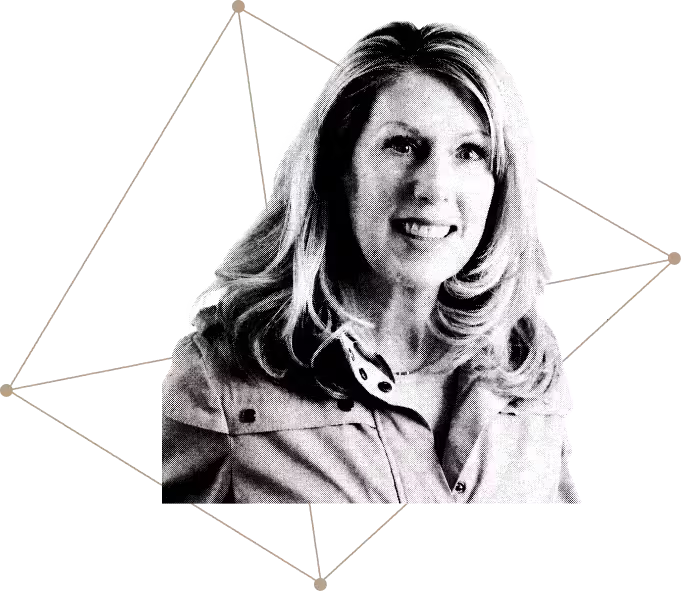
Kristine Gross
Chief Growth Officer
Kristine leads growth at Memry after 20+ years building go-to-market strategy across healthcare, SaaS, and fintech. A Stevie Award Winner for Women in Business, she also created a global reality show for Gen Z eco-entrepreneurs.

Greg Noble
Chief Technology Officer
Greg co-founded MedWorxs, building its ONC-certified EMR platform, then led Kovo HealthTech as CEO. He brings that experience to Memry. Accounting degree, University of Colorado. Raises chickens and turkeys on a farm in North Carolina.

Mathina Evans
Director of Product
Mathina leads product and integration at Memry. She started on the clinical floor, then built prior-authorization and Salesforce Health Cloud automation. Air Force veteran and volunteer at the VA.
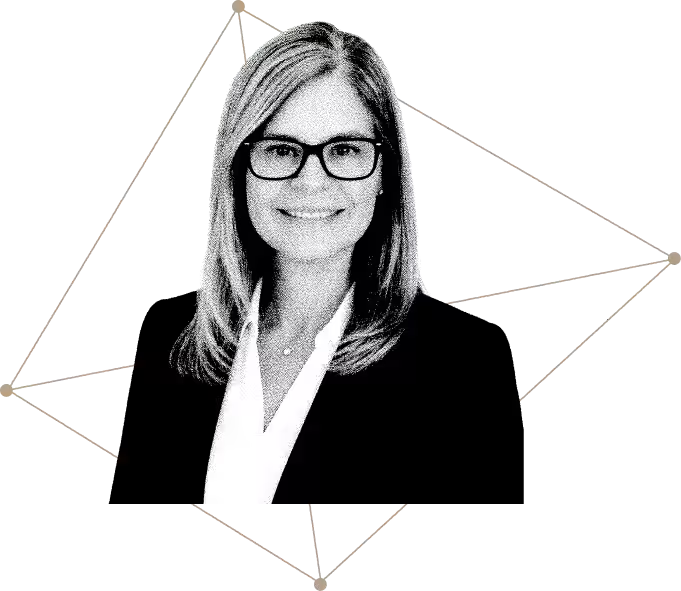
Stacey Tucker
Director of Clinical Systems
Stacey leads Clinical Systems at Memry, overseeing client support, implementation, and training after 20+ years in healthcare operations. MS, Healthcare Administration, Lindenwood University. Has traveled to 40 states and 23 countries.
“As a director responsible for onboarding and supporting new APPs, Memry is intuitive and easy to learn, which helps new providers become comfortable with the system quickly and focus more on the clinical workflow rather than navigating a complicated EHR.”
Cortney Seymour, CNP
Director of Advanced Practice Clinicians, MedOne
Room to think again
Most days, the software takes up more of your headspace than the patients do. Memry gives that part of your brain back, so the only thing that shows up in the room with you is you.

FAQ
Most post-acute providers run their own patient panels and cover several buildings without a dedicated care manager to lean on. Memry was built for that provider first — everything works without someone coordinating behind the scenes. For provider groups at scale, the same functionality scales up to more buildings and more providers. But the starting point was the individual.
Memry was built by providers, for providers, and it's still used today by the group who built it. They ran PALTC workflows manually — patient assignment on Excel, multi-building days, visit cadence rules, discharge summaries buried in 100 pages of hospital paperwork — and got tired of working around tools that weren't built for any of it. So they built Memry, tested it on real patient panels and facilities, and have spent the last 5 years improving it.
Memry is built for providers — physicians, nurse practitioners, and physician assistants working in post-acute and long-term care. NPs and PAs make up a real share of the people using Memry every day, including several of the clinicians who built it.
Yes — including buildings that combine more than one of those settings under one roof, which is common in this space and part of why most EMRs struggle with it.
ChartPath, GEHRIMED and DocNow were built for facility administration in an earlier era of this market, and largely stayed there. Memry was built by clinicians, specifically for the PALTC space, and designed around the way providers navigate patient encounters.
Most EHRs were designed for the hospital or the outpatient clinic and then stretched — awkwardly — to cover the nursing home and long-term care setting. "Built for post-acute medicine" means Memry starts from how care actually happens in a skilled nursing or long-term care facility: rounding on a full census, documenting on residents who stay for months or years rather than a single visit, coordinating across a rotating floor staff, and meeting the specific regulatory and billing realities of this setting.
The medicine qualifier matters — it's not just facility operations or scheduling. Memry is shaped around the clinical work of the providers who round in these buildings: the assessments, the medication management, the documentation that has to hold up for compliance and continuity across long stays.
When a workflow assumes a 15-minute office visit or a hospital discharge, it doesn't fit here — and Memry isn't built on that assumption.
Onboarding an individual provider typically takes hours to a couple of days rather than weeks — most providers are documenting confidently after a short orientation, with no multi-week training runway. A full facility or provider group takes a bit longer: setting up the census, configuring users and roles, and migrating records adds time, but the lift stays small compared to legacy systems.
Adding a new facility for a provider already onboard takes less than 30 minutes. We'll give you a concrete timeline for your group's size and setup during your onboarding conversation.
Yes. We bring over your existing patient records as part of onboarding — mapping your current data to Memry's structure, migrating demographics, active problems, medications, and relevant clinical history, and validating the results with your team before go-live. The exact scope depends on your current system and export format, which we'll scope together up front.
You get ongoing support from a team that knows post-acute, not a generic ticket queue. Support is tiered so response time matches the severity of the issue — routine questions go through standard channels, and anything affecting your ability to deliver care gets an escalated, faster response. We'll walk through your plan's specific SLA commitments during onboarding.
We think about training as getting your team confident quickly, not sitting through a course. Training is hands-on and role-based — providers learn the rounding and documentation workflows they'll actually use, and administrative staff learn setup and census management. We combine a guided walkthrough at go-live with reference materials your team can return to, and stay close during the first few weeks so questions get answered in real time. We also offer a dedicated in-person kickoff orientation, and the training program is actively expanding.
Today, Memry focuses on clinical documentation and workflow, structured to support accurate coding and clean billing downstream. Full revenue cycle management is on our roadmap, not fully built out yet. If RCM is a priority, tell us — we'll walk through what's available now, how Memry fits your current billing setup, and what's coming.